Here’s what most Bluetooth hearing aid guides written abroad get wrong for Indian buyers: they assume you own an iPhone.
Around nine in ten smartphones in India run Android. Yet a lot of hearing aid marketing still leads with “Made for iPhone” compatibility, and some older Bluetooth hearing aids genuinely work better with Apple devices than with the phone in your pocket.
That mismatch causes more disappointment than any other line on the spec sheet. So let’s start there, then work through what else matters.
Quick Summary
Bluetooth hearing aids connect wirelessly to your phone, TV and other devices, letting you stream calls and audio straight into your ears. In India they typically start around ₹25,000 and rise well into lakhs depending on brand, technology level and features. The things worth checking before you buy: whether the device streams properly to Android as well as iPhone, whether it supports hands-free calling, how streaming affects battery life, whether TV streaming needs a separate adapter, and whether the app is one you’ll actually use.
Key Takeaways
- Bluetooth hearing aids stream audio directly from phones, TVs and tablets
- India is an Android-majority market – confirm Android streaming before buying
- Prices generally start around ₹25,000 and go up to several lakhs
- Hands-free calling is a separate feature from audio streaming – check both
- Streaming shortens battery life noticeably; ask for a realistic daily estimate
- Some models need a separate TV adapter; newer ones stream TV directly
- Smaller in-canal styles sometimes limit Bluetooth performance
- A hearing test decides which model suits you – not the feature list
Bluetooth Hearing Aids Features That Actually Matter
- Android Compatibility, Not Just iPhone
This is the first question to ask in any showroom.
Apple devices use a protocol called Made for iPhone. Android uses a different one, and newer devices increasingly use Bluetooth LE Audio, the current standard that works across both.
If your household runs on Android – and statistically it probably does – confirm the model streams calls and audio directly to your phone, not just an iPhone. Some brands have supported Android properly for years; others arrived late.
Bring your phone to the appointment and ask the audiologist to pair it. Five minutes of testing beats any brochure claim.
- Hands-Free Calling vs Audio Streaming
People assume these are the same feature. They aren’t.
Audio streaming means the caller’s voice comes into your hearing aids. Useful, but you still speak into your phone.
Hands-free calling means the microphones in your hearing aids pick up your voice too, so the phone can stay in your pocket.
If you take calls while driving, cooking or walking, prioritise hands-free. Not every Bluetooth hearing aid offers it, and it’s rarely obvious in advertising.
- Battery Life Under Real Streaming Conditions
Every brand publishes a battery figure. Almost none assume you’ll stream for three hours a day.
Streaming drains a rechargeable hearing aid considerably faster than normal listening. Watch two hours of television and take an hour of calls daily, and your real runtime sits well below the headline number.
Ask directly: how long does this last with three hours of streaming? A good audiologist gives an honest answer rather than repeating the box figure.
- TV Streaming – Direct or Adapter?
For many families this is the feature that actually changes daily life. No more arguments about television volume.
But check how it works. Some hearing aids need a separate TV adapter plugged into your set, usually sold at extra cost. Newer models with Bluetooth LE Audio often stream directly. If an adapter is required, factor its price in before comparing quotes.
- App Control and Remote Fine-Tuning
Most Bluetooth hearing aids come with a companion app for volume, programs and sound adjustment.
Two things to check. Is the app stable on your phone? And does your provider offer remote fine-tuning – adjustments made without you travelling to the clinic? Where the nearest specialist centre may be in another city, that matters more than it does elsewhere.
- Style vs Bluetooth Performance
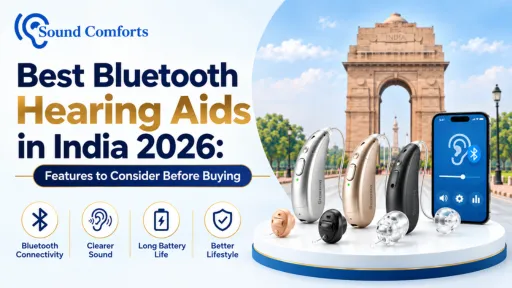
Bluetooth hearing aids come in several styles – behind-the-ear (BTE), receiver-in-canal (RIC), in-the-ear (ITE) and completely-in-canal (CIC).
Larger styles have more room for antennas and batteries, so they tend to stream more reliably and last longer. The smallest invisible models sometimes trade connectivity for discretion, though the newest generation has closed much of that gap. If invisibility matters most, say so – but ask what you’re giving up.
- Telecoil
A telecoil connects to hearing loop systems installed in some auditoriums, places of worship and public buildings. Loop coverage in India is patchier than in Europe, so this matters less for most buyers here – but if a venue you attend regularly has one, confirm the model supports it.
Bluetooth Hearing Aids Price in India 2026
Prices vary enormously by brand, technology level and style.
| Segment | Indicative price range |
|---|---|
|
Entry-level Bluetooth models |
From around ₹25,000 |
|
Mid-range |
Roughly ₹60,000 – ₹1,50,000 |
|
Premium and flagship |
₹1,50,000 upward, into several lakhs |
Three things to understand about these figures.
Check whether it’s per ear or per pair. Many quotes cover a single device. Most people with hearing loss in both ears need two, so always ask.
Technology level moves the price more than brand does. Most manufacturers sell the same model at several tiers – same shell, less automatic processing as you step down. If your week is mostly quiet, a lower tier often serves you perfectly well.
EMI is widely available. Most established Indian providers offer instalment plans, which changes what’s realistically affordable.
Major brands available in India include Signia, Phonak, ReSound, Widex, Starkey and Oticon. None is universally best – the right choice depends on your audiogram and your daily listening.
Get Your Hearing Tested First
Bluetooth is a convenience feature. It doesn’t change whether a hearing aid suits your hearing loss.
A proper evaluation – including speech testing in noise, not just tones – tells you which style and technology level you need. Buying on features alone is how people end up with expensive devices sitting in a drawer.
See a doctor promptly rather than shopping if you have sudden hearing loss in one ear, ear pain, discharge, dizziness, or ringing in only one ear. Those need medical attention first.
Conclusion
Choosing among Bluetooth hearing aids in India comes down to matching real features to your actual life rather than to a brochure, and the one worth checking before anything else is whether the device streams properly to the phone you already own – because in an Android-majority market, that assumption trips up more buyers than any technical specification does. Beyond that, the questions that genuinely change your daily experience are unglamorous ones: does it handle hands-free calls, how long does the battery really last when you stream, does television need a separate adapter, and will your provider adjust the devices remotely when you need it. Price matters too, and the range in India is wide enough that a careful buyer can find something suitable at many budgets – but the technology level you need is decided by your hearing test, not by what you can stretch to. Get tested first, take your own phone to the fitting, and insist on trying the device in a situation that resembles your ordinary week. That approach costs nothing and prevents the most expensive mistake in hearing care: buying the right device for somebody else’s ears.
Talk to SoundComforts
Choosing well starts with a proper hearing assessment, not a product catalogue.
At SoundComforts, our audiologists assess your hearing, explain which Bluetooth features genuinely suit your routine, and fit devices from the leading brands – with ongoing support afterwards.
Bring your own smartphone to the appointment. We’ll pair it during the fitting so you can hear exactly how it performs on your phone, not a demo unit.
Visit soundcomforts.com to book a hearing test or speak to an audiologist about Bluetooth hearing aids.
FAQs
What are Bluetooth hearing aids?
Bluetooth hearing aids connect wirelessly to smartphones, televisions, tablets and other devices, letting you stream audio directly into your ears. They also allow app-based control of volume and programs. Most current models from leading brands include Bluetooth as standard rather than as an optional extra.
What is the Bluetooth hearing aids price in India?
Bluetooth hearing aid prices in India generally start around ₹25,000 and rise to several lakhs, depending on brand, technology level, style and features. Always confirm whether a quoted price covers one ear or both, and ask whether EMI options are available before comparing providers.
Do Bluetooth hearing aids work with Android phones?
Most current models do, particularly those supporting Bluetooth LE Audio. Older models were sometimes optimised for iPhone first. Since India is an Android-majority market, take your own phone to the fitting appointment and confirm streaming works properly before purchasing.
Do Bluetooth hearing aids reduce battery life?
Yes. Streaming audio consumes noticeably more power than normal listening, so a device rated for a full day may last considerably less with several hours of calls or television. Ask your audiologist for a realistic estimate based on how much you expect to stream daily.
Can I connect Bluetooth hearing aids to my TV?
Often yes, though the method varies. Some models require a separate TV adapter sold at additional cost, while newer devices with Bluetooth LE Audio can stream directly. Confirm which applies to the model you’re considering, and include any adapter cost in your budget.